

By Christian Hudspeth, CFP(R)
Because you only get one chance to get it right, the age to start claiming Social Security benefits is one of the most important financial decisions every American makes in their lifetime.
So when is the best age to claim Social Security? Arguments abound on the subject, but the answer depends largely on three questions:
- Do you need Social Security to support your lifestyle between ages 62 and 70?
- Are you in good health and do you think you’ll live past age 80?
- Do you think your investments can generate 8% per year or more after taxes?
Today we look at why you (working with a trusted financial advisor) may — or may not — consider collecting your Social Security benefit at age 62.
Reasons to Claim Social Security Early at Age 62
According to the Social Security Administration data from 2022 (the most recent data available), collecting Social Security benefits at age 62 was the second most popular age for people to claim (22.9% of men chose this age compared to 24.5% of women).
Here are some of the top reasons people choose to collect Social Security benefits at the earliest age possible:
- It’s simple. Assuming you’ve worked at least 10 years in the US (or were married for 10 years to someone who did), citizens can apply as early as age 62 and start receiving a monthly income for life. There are no markets to research, investments to track, or commissions to pay for this virtually guaranteed income stream.
- Extra cash flow now means investments can keep growing. Having Social Security income to pay for your expenses in your earlier retirement years may allow you to leave your portfolio untouched for longer, allowing your life savings to grow in stocks and bonds for several more years.
- It’s more tax-efficient income than other income. Depending on your income sources (pension, IRA withdrawals, earned income, etc.), between 0% up to a maximum of 85% of your Social Security benefits may be subject to Federal income tax. Compare that to traditional IRA withdrawals or pension income, which are often 100% subject to Federal income tax.
Reasons to Wait to Claim Social Security Until After Age 62
Then again, there are well-founded reasons to delay claiming until later. And many of them center around other factors and financial goals that may be in your life.
- If you claim at age 62, you’d have benefits starting sooner but they’d be reduced by 30%, or $2,813 per month.
- If you claim at age 70, you’d start receiving benefits later but collect the maximum benefit of $4,982 per month.
- Look at your benefit in context with your retirement assets, living needs, and legacy goals
- Assess your spouse’s (or ex-spouse’s) Social Security benefit
- Show you an optimal claiming strategy to maximize both of your lifetime benefits with your other top financial goals in mind
1. Delaying Social Security benefits offers an excellent return on investment. If you’re working a part-time job or have ample portfolio funds to support yourself without Social Security benefits in your early 60s, you may be better off delaying to get a larger benefit.
Let’s say your full retirement age (FRA) benefit at age 67 is projected to be $3,000 per month. Collecting early at age 62 would give you a reduced benefit of $2,100 per month (30% less). If you were to instead wait until age 70, your benefit would be 124% of your FRA, or $3,720 per month.
Put another way, delaying benefits until age 70 would yield a 77% larger benefit than claiming at age 62. Averaged over eight years, that’s the equivalent of a 9.6% per year return, tax free.
2. Your other assets may offer more tax-efficient income than Social Security. If you have investments held in taxable investment accounts, only the gains are taxable and at capital gains tax rates which are much more favorable than ordinary income tax rates.
For example, say you invested $30,000 in a stock years ago and it grew to $45,000. If you sold it today and withdrew the proceeds, only the $15,000 gain is taxable. At a 15% capital gains tax rate, the tax would be $2,250 — just 5% of the full $45,000 withdrawal.
Compare that to $45,000 in annual Social Security benefits. Up to 85% of the benefit would be taxable ($38,250), but that would be taxed at ordinary rates. At a 22% ordinary tax rate, the tax would be $8,415 – or 18.7% of the $45,000 income.
Bonus Tip: By living off of your low-tax portfolio dollars instead of Social Security for a few years, you can use Roth IRA conversions to take advantage of low tax rates and dramatically reduce the amount of taxes you pay over your lifetime. We talk about how in “How to Pay Little to No Taxes in Retirement and Leave a Tax-Free Inheritance.”
3. Delaying may maximize your lifetime benefits. No one knows when they’re going to die, but Social Security actuaries indicate that a 65-year-old has between a 62% and 72% chance of living past age 80.
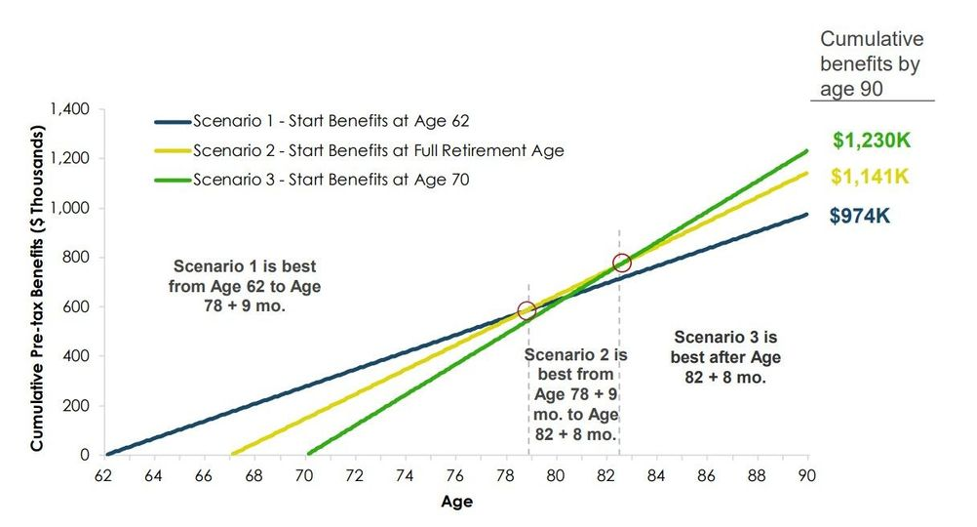
Let’s assume you’re projected to receive a Social Security benefit of $4,018 per year at your full retirement age (FRA).
As shown in the chart below, if you were to claim at age 70 and live until age 90, you’d have collected $256,000 more in lifetime benefits ($1.23 million versus $974,000) than if you’d claimed at age 62. Claiming at age 62 would only yield more in lifetime benefits if you died before the age of 79.
The Takeaway
As you can see with all the reasons you may – or may not – take Social Security at age 62, the right age to claim your Social Security benefit is a crucial decision that can’t be made in a vacuum.
While we’ve looked at several points to consider as a starting guide, a choice this important merits working with a trusted financial advisor who can:
Ready to get this conversation started? Reach out to the author (and CERTIFIED FINANCIAL PLANNER™) at chudspeth@fmpwa.com.
Next: “Our Top 5 Most-Asked Social Security Questions – FMP Wealth Advisers”
*The information presented here is not specific to any individual’s personal circumstances. FMP Wealth Advisers is not providing investment, tax, legal, or retirement advice or recommendations in this article.
**To the extent that this material concerns tax matters, it is not intended or written to be used, and cannot be used, by a taxpayer for the purpose of avoiding penalties that may be imposed by law. Each taxpayer should seek independent advice from a tax professional based on his or her individual circumstances.
***These materials are provided for general information and educational purposes based upon publicly available information from sources believed to be reliable — we cannot assure the accuracy or completeness of these materials. The information in these materials may change at any time and without notice.